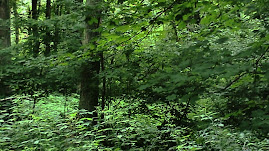
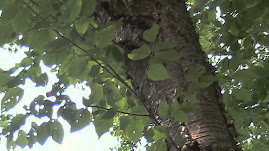
So thrilled to welcome Wood Ducks to White’s Wetland! Now as strange as that may sound, because Wood Ducks are native to North America and we are definitely in their breeding range, the fact is that we have never been honoured with their presence before. So to have three Wood Duck pairs as “regulars” on the White’s Wetland pond is indeed a privilege. I tend to agree with many North American naturalists who say that the Wood Duck has to be North America’s most beautiful waterfowl species. The male Wood Duck is so ornately and highly coloured that it is hard to lower the binoculars and look elsewhere.
Our ducks, like so many others, arrived here in April from their wintering grounds in the southern United States. But their presence here, on our pond, tells us something very important about the health of the White’s Wetland ecosystem. Their choice of this wetland tells us that they are finding the habitat they need to live, nest and survive. That means a freshwater wetland, a riparian habitat and plenty of the vegetative material they love. Aquatic plants such as algae, duckweeds, sedges, grasses and pondweeds make up the adult diet along with aquatic insects, while ducklings (come June!) will require a high protein diet; they’ll eat dragonflies, bugs, beetles, and spiders during the first few weeks of life. According to the Hinterland Who’s Who site, “High populations of these small creatures are essential in habitats where the young will hatch and develop.”
Wood ducks feed primarily in shallow water areas, but they’ll also forage on the forest floor for seeds, acorns and nuts. Some ducks, it has been noted, will field forage for corn. Like their name suggests, Wood Ducks are just as much at home in the woods as they are on the water. Wood Ducks are perching ducks; they nest in trees. Left to their own devices, they’ll choose holes in hollow trunks or similar cavities. However, nesting boxes can be created for them, and they have proven to be beneficial for duckling survival rates, if constructed properly and placed in well-chosen locations.
Wood Ducks were hunted to the brink. (What else is new?) But Wood Duck populations have recovered and continue to recover. Thank goodness, because to lose this beautiful, colourful, peaceable bird would be tragic.
However, the largest threat to their future continues to be…yes, you guessed it, the continued loss of habitat. Landowners everywhere, both sides of the border, can encourage Wood Duck populations by protecting and restoring floodplains, wetlands, rivers, streams and woods on their property.
Acorns and other forest mast are important fall and winter foods. So plant oaks if you are reforesting, or choose hickory and black gum.
Native wild grass mixes are available at seed stores (check out the Ontario Seed Catalogue – they have the best seeds!).
Other plant species suggestions can be found in this leaflet:
ftp://ftp-fc.sc.egov.usda.gov/WHMI/WEB/pdf/woodduck(1).pdf
And if you want to learn how to build nesting boxes for them, visit The Wood Duck Society.
Wednesday, April 18, 2012
Monday, April 9, 2012
Saving The World's Disappearing Amphibians
Saving amphibians means saving their habitat, and that means saving wetlands from development and destruction.
Visit Dr. Kerry Kriger's Save The Frogs organization to learn why amphibians are so vitally important to many other species on this planet and how we can help them to survive.
These extraordinary creatures have evolved and diversified over millions of years, but now amphibian populations are on the decline everywhere. Already 200 amphibian species have gone extinct worldwide since 1979. As sensitive bio-indicators of planetary health, this should be telling us something. Amphibians in peril means we are all in peril.
Time to change our destructive ways. Time to raise awareness and time to act.
International Save The Frogs Day is April 28, 2012. We'll be blogging about frogs and tweeting from a real pond all day long! So come back and visit us on April 28th. Ask questions or post comments on White's Wetland "Frog Blog" on April 28th!
Labels:
amphibians,
endangered species,
Save The Frogs Day
Sunday, January 29, 2012
Recommended Winter Reading
Snow days or no-snow days, winter does tend to keep us inside more, so here's a worthwhile read. If you enjoyed David Suzuki's Nature of Things episode on the animal mind recently, you will definitely want to delve into biologist Marc Bekoff's book. The Suzuki episode was just a teaser on this profoundly important topic.
And here's an intriguing passage that tickled my "tiny green" fancy:
In my musings about animal emotions I also can't help wondering, What about the insects? Do even mosquitos have emotional lives? Of course, mosquitos have tiny brains and lack the neural apparatus necessary for the evolution of emotions, so it's doubtful they do. But in truth, we just don't know. One day, perhaps we'll figure out a way to determine this. More important, however, would it make a difference to us if they did? It should, just as it should make a difference to us that other animals have emotions. Knowing that animals feel - and being able to understand them when they express joy, grief, jealousy, and anger - allows us to connect with them and also to consider their points of view when we interact with them. Knowledge about animal passions should make a difference in how we view, represent, and treat our fellow beings.
Thursday, January 26, 2012
Nature Near Home...
A lone wild turkey walks through the field near the house.
“After long experience, I am convinced that the best place to study nature is at one’s own home, — on the farm, in the mountains, on the plains, by the sea, no matter where that may be. One has it all about him then….The wild creatures about you become known to you as they cannot be known to a passer-by.”
John Burroughs,"Nature Near Home"
Field and Study (1919)
Saturday, December 31, 2011
I'm going to work for Planet Earth in 2012...How about you?
Our planet can no longer wait for us to grow up and wake up! So with a new year only hours away, let's make a commitment - a resolution if you will - so that 2012 is the year that grassroots humanity takes charge and takes back the Earth, for all people and all species.
So goodbye Greed, Waste, Carelessness and Irresponsibility. Tell bad corporate citizens what they can do with their dirty products and practices. Remind governments what they should be doing for their people and the planet, instead of serving big business and the investment bankers. Take action. Speak up. Become an activist for Earth.
It's our only home, this pale blue dot swimming in a sea of space...
Let's mobilize for Mother Earth! There is so much we can do, so much work to be done.
Bless the Earth this New Year's Eve.
Sunday, November 13, 2011
WINDFALL: The Movie
A must-see documentary from the U.S. The situation is slightly different in Ontario, where the McGuinty government has shown little regard for rural rights and has aided Big Wind to walk all over the province without really addressing the complexities of the issue first.
Yet the stunning lack of democracy on this side of the lake is perhaps not all that different from the frontier-like free-for-all happening in upper New York state, because in the end there is only one winner in this seedy little shell game that touts itself as "green" and that's Big Wind - the wind corporations, now the billionaire heirs to Big Oil.
Funny how it's always the little guy who gets hoodwinked and stomped on. Make no mistake, neither you nor the planet is going to benefit from this latest big bucks, big business bamboozle. Certainly not the birds, the bats and the butterflies.
We must ensure a moratorium on ALL new wind facilities before any more are erected and we must demand that ALL wind farms undergo independent environmental assessments by scientists, biologists, ornithologists and ecologists.
We cannot lose our precious million-year-old migration routes to the latest wave of corporate greed just because it come wrapped in green packaging.
Learn and read about the true cost of wind, and why we need to look at alternatives to the alternative.
We can do better than this. And we must if we want to call ourselves environmentalists.
On a final note, I took a trip to the Port Burwell wind farm a few months ago, where some 60-odd turbines tilt at the skies from their jagged stride across the lush southwestern Ontario landscape. That is to say, the ones that were actually working were "tilting." A few stood motionless, a small red light indicating they were not functioning.
I watched two tiny specks come into view. Birds. Blackbirds, I believe. I did not have my binoculars, so I am surmising. I watched the two birds for several minutes. They were flying ominously close to a turbine, ominously close to the giant multi-ton paddles. I sucked in my breath. I was hoping against hope...
and then there was only one speck left.
One. The other bird was gone. Vanished. Annihilated.
I did not have my binoculars. But one second there were two birds, lazily and leisurely drifting across a late summer sky...
and then there was one.
I have been bloody angry ever since.
Yet the stunning lack of democracy on this side of the lake is perhaps not all that different from the frontier-like free-for-all happening in upper New York state, because in the end there is only one winner in this seedy little shell game that touts itself as "green" and that's Big Wind - the wind corporations, now the billionaire heirs to Big Oil.
Funny how it's always the little guy who gets hoodwinked and stomped on. Make no mistake, neither you nor the planet is going to benefit from this latest big bucks, big business bamboozle. Certainly not the birds, the bats and the butterflies.
We must ensure a moratorium on ALL new wind facilities before any more are erected and we must demand that ALL wind farms undergo independent environmental assessments by scientists, biologists, ornithologists and ecologists.
We cannot lose our precious million-year-old migration routes to the latest wave of corporate greed just because it come wrapped in green packaging.
Learn and read about the true cost of wind, and why we need to look at alternatives to the alternative.
We can do better than this. And we must if we want to call ourselves environmentalists.
On a final note, I took a trip to the Port Burwell wind farm a few months ago, where some 60-odd turbines tilt at the skies from their jagged stride across the lush southwestern Ontario landscape. That is to say, the ones that were actually working were "tilting." A few stood motionless, a small red light indicating they were not functioning.
I watched two tiny specks come into view. Birds. Blackbirds, I believe. I did not have my binoculars, so I am surmising. I watched the two birds for several minutes. They were flying ominously close to a turbine, ominously close to the giant multi-ton paddles. I sucked in my breath. I was hoping against hope...
and then there was only one speck left.
One. The other bird was gone. Vanished. Annihilated.
I did not have my binoculars. But one second there were two birds, lazily and leisurely drifting across a late summer sky...
and then there was one.
I have been bloody angry ever since.
Record Day for Raptors of All Kinds
And there's more about the marvels of migration in this recent London Free Press article.
The sheer number of birds that were observed should serve as a reminder to all why this must remain a migratory corridor, not a wind turbine corridor.
Record Day at Hawk Cliff
The sheer number of birds that were observed should serve as a reminder to all why this must remain a migratory corridor, not a wind turbine corridor.
Record Day at Hawk Cliff
Migration of the Raptors - Hawk Cliff, Lake Erie
A couple of pictures taken at Hawk Cliff, on the shores of Lake Erie, one of the key sites for observing migrating hawks in North America.
Learn more about Hawk Cliff Foundation
Hawk Bander: Cyril Crocker
Learn more about Hawk Cliff Foundation
Hawk Bander: Cyril Crocker
Wednesday, August 3, 2011
Industrial Wind Turbines, Migratory Birds and Political Shenanigans
If you are interested in expanding your understanding of this issue, the impact of IWTs on migratory birds, I urge you to read Wayne Wegner's passionately argued and brilliantly articulated essay, Location, Location, Location…Migration, Migration, Migration, embedded in the Middlesex Wind Action Group website. Scroll down through Issues, you will find it under the category "Wildlife."
Tuesday, August 2, 2011
The Wind Issue
As a follow-up to the previous post about wind farms, here are two links of note:
If you live in Middlesex County and have serious reservations about the continuing construction of wind farms in the county and in southern Ontario without proper environmental assessment and public input, then see what the Middlesex Wind Action Group has to say.
To gain a greater understanding of the issue and to learn more about the actual efficacy of wind energy, please visit Ontario's Wind Performance.
If you live in Middlesex County and have serious reservations about the continuing construction of wind farms in the county and in southern Ontario without proper environmental assessment and public input, then see what the Middlesex Wind Action Group has to say.
To gain a greater understanding of the issue and to learn more about the actual efficacy of wind energy, please visit Ontario's Wind Performance.
Subscribe to:
Posts (Atom)